
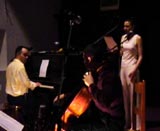
Autunna et sa Rose have used material from their
first 3 albums, hereby interpreted on piano and cello, and featuring soprano
vocals and poetic recitation. Saverio, the group's mastermind, and his
companions bring to life dramatic pieces that push the typically softer
tones of Neo-Classical music into a more demanding ground dominated by
Contemporary Classical music. Interpretations of compositions by Ataraxia
and Tuxedomoon were also part of the concert recorded in Rovigo that evening
and included in this release.
 |
01. L'Art et la Mort (5:44) 02. Caresses aux Coeurs (5:20) 03. Gentiane Percluse (4:53) 04. La Morte di Virginia (4:39) 05. Slow Rain (4:32) [ .mp3 excerpt ] 06. Rose Jaune de Novembre (2:25) [ .mp3 excerpt ] 07. Verganglichkeit (5:39) 08. Landschaft der Vergangenheit (2:34) [ .mp3 full track ] 09. Canzona (3:33) [ .mp3 excerpt ] 10. Egypt (3:52) 11. Temps Fumé (7:43) |
Tracks 8, 9 and 10 were previously unreleased; tracks
1, 4 and 5 originally appear on "Sous la Robe Bleue" (1996,
Ederdisia); tracks 2, 3 and 7 originally appear on "Sturm" (2001,
Materiali Musicali); tracks 6 and 11 originally appear on "Né
l'etre... éternel" (2000, Metaluxor).
 It
was under the intimate and faint twilight light, in the now distant 1994,
that a young Emilian duo (Daria and Disorder) originated an ambitious
multimedia project named Autunna et sa Rose. “Multiexpressive”
is probably the best single-word expression describing the multifaceted
nature of the project. Many artistic aspects such as cinematography, figurative
arts and most of all theater, as the ideal of “utter art”, comprising
all arts, blend in it. The whole surrealistic avant-garde (Antonin Artaud’s
works in the first place) and the themes connected to it, such as loneliness,
the state of neglect and extreme romanticism, stand as the original source
of inspiration. A&sR’s debut dates back to 1996, with “Sous
la robe bleue”. This cd is a special kind of concept album compared
to a psychodrama where an imaginary female character is unable to find
the love she needs to survive and ends up dying of this. Most of the texts
are recited, as in a theatrical dramatisation; the whole work is focused
on the inability of a real and deep communication. Both critics and audience
praise this debut. It is an unexpected success even for the authors, considering
the complexity of the work.
It
was under the intimate and faint twilight light, in the now distant 1994,
that a young Emilian duo (Daria and Disorder) originated an ambitious
multimedia project named Autunna et sa Rose. “Multiexpressive”
is probably the best single-word expression describing the multifaceted
nature of the project. Many artistic aspects such as cinematography, figurative
arts and most of all theater, as the ideal of “utter art”, comprising
all arts, blend in it. The whole surrealistic avant-garde (Antonin Artaud’s
works in the first place) and the themes connected to it, such as loneliness,
the state of neglect and extreme romanticism, stand as the original source
of inspiration. A&sR’s debut dates back to 1996, with “Sous
la robe bleue”. This cd is a special kind of concept album compared
to a psychodrama where an imaginary female character is unable to find
the love she needs to survive and ends up dying of this. Most of the texts
are recited, as in a theatrical dramatisation; the whole work is focused
on the inability of a real and deep communication. Both critics and audience
praise this debut. It is an unexpected success even for the authors, considering
the complexity of the work. They take part in various german samplers in 1997, at the Virgin Prunes tribute with the orchestral cover of “Decline and Fall” (1998), that specialist press considered the best track of the collection. In February 2000 their second and most awaited album is released with the title “Né l’être… éternel”.
This new album had been scheduled in 1998 but the bankruptcy of the german label A&SR had signed with caused the entire project to stall for more than a year, until the agreement with Radio Luxor came.
The long waiting doesn’t disappoint the expectations of the ones that were moved by “Sous la robe bleue”. “Né l’être… éternel” denotes a remarkable marutity both artistic and in composition, enriched by the cooperation of a few musicians with a classical background (N. Bosi playing cello, L. dal Pozzo trumpet, A. Madau violin) and the presence of an alto, N. Guelfi in a remarkable vocal trio “a cappella”.
The theme of the spirit’s eternity generating energy, of death as an essential part of life and the search for a symbiotic relationship with a Nature modern human beings have a great need to be reconcilied with divides in two distinct halves. The first one comprises 4 chamber music pieces while the second one consists of 4 orchestral pieces. Actually the number 4 represents Nature and the elements that form it.
With this work, that surprises audience and critics once again, A&SR confirm their musical tendency towards a historical and cultural period that is clearly romantic. It embodies the emotional and passionate impetuousness they portray.
In August 2000 the multimedia show of “Né l’être… éternel” is on stage during the exhibition “Corposamente”. Gianluca Lo Presti, an already well-known artist on the alternative national scene takes part in it, mainly as a guitarist, with Disorder (the only member from the original duo).
Before the release of “Né l’être… éternel”, Disorder conceives the idea that will become A&SR’s third official release in February 2002, “Sturm”. It is an ambitious work with the exceptional participation, besides that of G. Lo Presti, of one of the historical leaders of Tuxedomoon: Steven Brown.